Showing posts with label keynote. Show all posts

Tuesday, May 27, 2014

What if You Can't Answer a Question?

Have you ever had the experience of presenting at the front of the room to prospects and someone throws a curve-ball question, catching you off guard?  It happened to me, early in my business marketing career and I'll remember that uncomfortable moment forever.   Here's my advice if this ever happens to you.

Rule one is DON'T FAKE IT. If you get caught making up answers or providing inaccurate information, it could hurt your credibility. First, acknowledge the person who asked that question for asking a great question. Then, admit that you don't have the answer but confidently declare that you will find out. Offer the person asking the question your business card and ask him or her to follow up with you at a later time for the answer to the question after you've had time to research it.

In my situation, it wasn't about providing inaccurate information. I made the awful mistake of using a handout that I didn't develop and someone offered me. Basically, I didn't review all of the information on it. Someone had a question on information that was listed on the backside of the handout and I had no clue what it was referring to. I must have had the deer in the headlights look and learned a valuable lesson that day; always know what's on your handouts!

Friday, May 23, 2014

When Someone Violates My Right to a Break!

Doesn't it drive you crazy when attending a meeting or a conference and the speaker/expert goes over his or her time? As soon as they have met their time requirement, I find myself looking at my watch and wondering if I've going to get the break I've been waiting for to get another cup of coffee or make it to my next appointment or not.

Audiences don't appreciate it when a speaker goes beyond the time frame they've been given. If the meeting agenda indicates that the speaker will speak for 45 minutes, they expect them to NOT go beyond that time limit. And when a speaker does violate that time expectation, the audience begins to lose interest in the presentation. To your audience, a speaker going over time could mean a long running meeting for them and a loss of their next break. 

Practicing your speech with a timer will certainly help you pair your talk with the time slot you've been given. Place a visual and silent timer in front of you that you can watch. There are some great FREE apps for smart phones and tablets that are easy to use. At the very least, seek out a volunteer at the front of the room to keep time for you and to discretely notify you when your time is running out.

Thursday, May 15, 2014

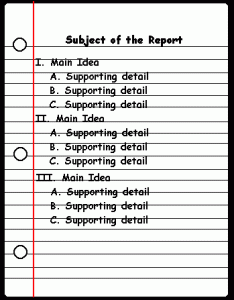
Should You Outline or Write a Speech?

A sales manager approached me following my presentation at a chamber breakfast event. He said he was going to be giving a speech at a business networking event and he was working on constructing his talk. He wanted some speaking coaching from me. He asked me, "What works better: making an outline or writing out the whole speech?"

There are many different solutions to this question, and many based on the speakers style or learning ability. So I suggest doing both. In preparation for your speech, sit down and write it all out, word for word, imagining yourself speaking it to an audience. Then, go back and create an outline from what you've written. Once your outline is finished, destroy the full speech you wrote. Doing a presentation word for word from memory is discouraged because memorized speeches don't usually come out natural. But having seen your presentation on paper and then having an outline to go by, your memory will retain the major components of your speech to give you talking points.

Whether you're speaking from your soapbox (a small and informal group gathering) or the stage (a formal business event), marketing yourself in front of your audience means being confident in yourself, your products or your services. Get to know yourself and practice developing and giving presentations. Find your local Toastmasters chapter to practice your talks and get some networking in at the same time.

Sunday, August 4, 2013

Why Start a Speaking Business?

Become a speaker from the soapbox to the stage
Image courtesy of Master isolated images
and www.freedigitalphotos.net
I asked myself this very question many times and I came up with two basic answers. The first answer is so I could stop existing as someone else’s employee. There’s nothing wrong with working for someone else. There’s just something very fulfilling about being able to take care of yourself and your family doing something that you love to do. The second answer is because it allows me to live a more fulfilling life by using my passion and gifts to help others live a better life. 

Now, if you already love what you do then perhaps you’re already on the right track and just have to make a slight switch at the next ‘junction.’ Maybe it’s time to change from working in the trenches to helping all those people that are in the trenches with you.

The reality is that too many people feel trapped in a job they hate going to everyday. Just look around you the next time you’re at the grocery store, the coffee shop or at the mall. Sometimes it feels like you’re living in a zombie movie surrounded by the walking dead. 

So many people doing the same thing day after day, existing for the sole purpose of producing for someone or something else, and once those widgets have been produced, they get their reward of returning home to the sofa and their television or computer each night. They sit there, remote control or mouse in hand feeling unfulfilled and empty, ready to give up the idea of searching for a more meaningful way of living. 

In the early 1980’s I began my journey as one of the walking dead. I was just out of the US Air Force and my grandmother told me I should go into the field of data processing because it promised good pay and good benefits. My grandparents were hard-working immigrants who came to this country as children. They did whatever it took to pay the bills and they did it well. But, they also complained about their employers, their jobs, the neighbors, and pretty much everything else. They weren't fulfilled and happy. Still, I had great respect for my grandmother so I took her advice.

Within a few months I found myself working for a bank, mounting magnetic reels on tape drives and loading and unloading giant reams of green and white striped paper called green-bar into humongous printers. I spent my days punching cards and bursting forms until I eventually moved into programming and from there onto management. 
I’m not telling you this to fault my grandmother; she was only doing what she had been programmed to do too. 

Besides, I was making good money and had good benefits. I’m telling you this because back then, I didn't know it was okay to dream of being all that I was meant to be in this life. I didn't have any idea that I had a passion for speaking about families and parenting just waiting to be found. 

Maybe you've been living your parent’s dream, someone else’s dream, or you've become a member of the ‘walking dead’. If this sounds like you, then this is the perfect time to discover new dreams or to reconnect with dreams you've been denying all along. Right now is the perfect time to reach deep inside yourself to discover and remind yourself of all the ideas that light your soul on fire. 

What do you love to talk about so much that when you talk about it, you feel alive? What have you discovered in your life that you’d like to share with others so that they can start living a better life too? What guilty pleasures would you love to bring out into the open? 

Are there things that you know how to do really well? Do you have natural talents that others would love to hear about, or that you could teach? What have you learned ‘the hard way’? What insight or knowledge do you possess that you could talk about right now rather than waiting until it’s time for your last lecture?

Wednesday, July 31, 2013

Answering Audience Questions

Someone asked me how I prepare for the questions I get as a speaker, from my audience members so that I can answer them without the help of cue cards or notes.

First of all, I always take questions following a lecture, keynote or presentation.  It is a common site for me as a speaker to have a line of people waiting at the front of the room when I come off of the stage. At conferences, I do my best to return to my book-signing table so that I can greet my audience members and hear their encouraging words of how much they enjoyed my presentation.

Running a speaking business means preparing for questions by knowing my passion, my material, and everything possible about my field of expertise. And with the ability to “stand in my client’s shoes,” I’m also able to anticipate my customers or audience member’s questions as a speaker

Some of the questions I get are about my competition or other authors or parenting experts. So I'm constantly reading other parenting experts materials or website to get to know them. I like to know exactly what makes them similar to or different from me so that I can answer my potential client's question.

If I can't answer the question, I get the person's contact info and promise to get back to them with the answer. If I get a question that has a long answer, I ask the person to see me following the event so that I don't hold up the rest of my audience and can provide an adequate answer. So, to recap, preparing for questions means becoming a true expert in your passion or your field of expertise; READ, LEARN AND READ SOME MORE.

Find more tips for building your speaking business in m book FROM THE SOAPBOX TO THE STAGE: HOW TO USE YOUR PASSION TO START A SPEAKING BUSINESS (http://StartaSpeakingBusiness.com)